
Donor outreach 101: How to reach, engage, and retain modern donors


Fundraising success starts with effective and thoughtful outreach. But in today’s landscape, donor engagement is harder than ever.
According to the CCS Fundraising Pulse Report 2025, nearly 70% of nonprofits say acquiring or retaining donors are the top challenge faced by their engagement teams. Modern donors expect personalized communication, real relationships, and a seamless experience across multiple channels.
The fundamentals of donor outreach in 2025 center on personalization, technology, and long-term engagement strategies.
Your team can use these basic concepts to build more meaningful connections that build loyalty while driving action and growth. For a complete roadmap to donor acquisition, download the free Gravyty Ultimate Donor Acquisition Playbook.
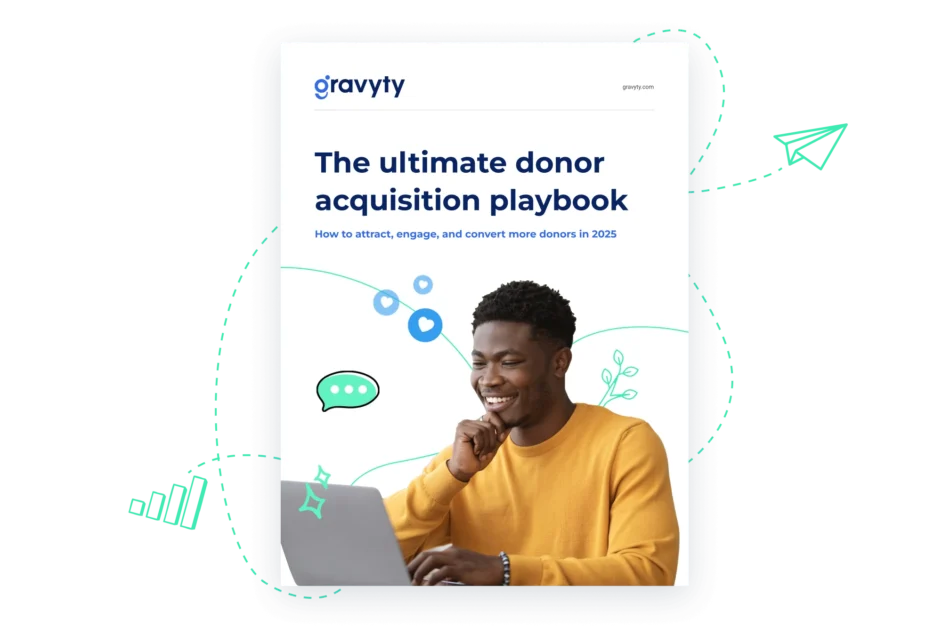
The ultimate donor acquisition playbook
This playbook walks you through a 6-step strategy that helps you connect with the right people, deliver relevant outreach, and guide donors from first gift to lifelong support.
What’s inside:
- Breakdown of the donor development cycle
- Ways to move beyond transactional outreach into relationship-first strategies
- Reflection prompts to align your team around what works
Know your audience: Segmentation & smart prospecting
To effectively reach your donors, start by understanding who they are. This means using data to segment your audience and identify your best prospects and the best way to meet them.
Donor data can reveal high-potential supporters when you group potential donors by characteristics like their giving history, interests, age (generation), and level of loyalty. Instead of sending the same message to everyone, segmentation lets you personally tailor outreach for each group so it truly resonates with each of them.
Consider segmenting donors by key factors like:
- Past giving behavior: Recency, frequency, and amount of past donations.
- Interests and affinities: What programs or causes do they care about most? What drives them?
- Generation or age: Communication preferences often differ by generation. Meet your donors where they are.
Each donor segment can respond very differently depending on the approach. For example, older donors might prefer phone calls or mail and value seeing that your organization is well-run and organized, whereas younger donors tend to engage via text, email, or social media and respond more directly to stories with emotional impact.
If you take the time to really understand what makes each of your donor segments different, you can approach each group more effectively and make every outreach effort feel personal.
Data-driven prospecting goes hand-in-hand with segmentation. Rather than guessing who to contact next, use tools like your CRM or even artificial intelligence to spot “hidden gem” donors in your database who have untapped potential.
Insights from the CCS Philanthropic Landscape also stress the importance of adjusting strategy for generational giving habits, ensuring outreach resonates across age groups.
Meet donors where they are with multi-channel outreach
Donors aren’t all in the same place, so your outreach can’t rely on a single channel. The most successful fundraising teams engage supporters across multiple channels (email, phone, social media, direct mail, text, and in-person) to meet donors where they are most comfortable.
Recent industry benchmarks confirm this multichannel reality: 80% of fundraising teams use social media and 58% use video messaging, while 85% of teams still rely on direct mail. This mix shows the need to combine online and offline tactics to maximize the reach of your efforts.
One person might see your story on social media, read an email about it, and later get a personal call. Each touchpoint reinforces your message and increases the chance of a response.
Counterintuitively for this digital era, research from Arizona State University shows that direct mail is still among the most effective ways to acquire new donors who become recurring contributors, while digital channels excel at frequent updates and relationship building.
An extremely effective example is the U.S. Department of Health’s DoNation campaign, which used email, mail, live events, and peer engagement to generate over 23,000 new organ donor sign-ups in just one year. Meeting donors through a variety of touchpoints created momentum that no single channel could have achieved alone.
Make it personal by leading with relationships
Donor outreach can’t be just about transactions. Effective outreach is about building relationships. People give to organizations they trust and feel connected to. That’s why successful fundraisers prioritize personalization in their communications.
Rather than blasting out generic appeals, tailor your messages directly to each donor’s history and interests. Reference the programs or funds they’ve supported and the passions they’ve expressed. Show that you know and value them as individuals, not just as dollar signs.
Not every communication needs to include an ask. Send sincere thank-you notes, impact updates, and occasional check-ins with no solicitation attached. For example, after someone gives, follow up to tell them how their gift helped – maybe share a story of a person or project that benefitted.
This keeps the donor emotionally invested in the mission. As the Gravyty Ultimate Donor Acquisition Playbook explains, “the best fundraisers know that successful solicitation starts long before the ask.”
Another way to deepen relationships is to leverage your strongest advocates. Volunteers are often the greatest champions of a mission, but they are frequently not tapped for donor outreach. Involving them in fundraising conversations, or asking your more loyal donors to share their experiences with peers, adds authenticity and reinforces the bonds within the community you’re building.
Use technology to multiply your team’s impact
For teams with big goals but limited staff, technology can be an absolute game-changer. The right tools help you do more with significantly less effort, so you can reach more donors without burning out your volunteers and outreach teams.
A good donor relationship management system centralizes donor information and interactions, making it easy to track touchpoints, set reminders, and ensure no donor slips through the cracks. Automated systems can handle routine tasks, like sending thank-you emails, birthday messages, and event invites, freeing up your team for higher-value interactions.
Artificial intelligence can further amplify your efforts. AI is able to analyze donor information to identify and flag patterns, such as predicting which donors might upgrade their giving or which lapsed donors could be re-engaged. 31% of teams actively using AI today report improved engagement and efficiency.
Technology can also help preserve the personal touch at scale. Video is one of the most powerful ways to stand out in a crowded inbox. With platforms like Gratavid, you can record a one-minute thank-you and send it broadly, creating authentic, face-to-face moments without needing dozens of meetings.
Donors remember personal touches, and video helps scale them across a growing supporter base.
Think long-term with stewardship & donor retention
Effective outreach isn’t just about the next gift. The most effective outreach is about long-term relationships and loyalty over time. Building a sustainable program means investing in stewardship.
When you keep donors engaged after they give, you dramatically improve retention and lifetime value. For example, monthly donors give 42% more each year than one-time donors, and their retention rate is nearly four times higher than first-time givers.
Strong stewardship starts with gratitude. Every gift deserves a heartfelt thank-you, ideally with context about what it achieved. Follow that with impact stories, photos, or testimonials to show donors the results of their generosity. Events can reinforce these relationships, too.
Research from the University of Kentucky found that diversifying event strategies, using data, and clearly showing impact are key to success. Treat events as opportunities to steward donors, not just solicit them.
Stewardship also requires consistency. Studies on donor retention emphasize that ongoing communication, acknowledgment, and recognition significantly reduce attrition. Even seemingly small actions like a thank-you call from a board member can turn a one-time donor into a long-term supporter.
Measure, learn, repeat: Use data to refine donor outreach
The most effective teams commit to measuring results and learning from them. Key metrics include donor retention rate, response rate, average gift size, and acquisition costs. Tracking these regularly helps you identify what works and where to pivot.
For example, if peer-to-peer campaigns generate higher retention than ads, you know where to double down.
As the Gravyty Ultimate Donor Acquisition Playbook notes, teams that consistently analyze outreach performance see stronger long-term outcomes. Similarly, the CCS Philanthropic Landscape highlights how data-informed strategy adjustments improve donor engagement year over year.
Regular debriefs after campaigns, combined with a willingness to test new approaches, ensure your outreach evolves with donor expectations.
Building donor relationships that last
Ultimately, donor outreach is about more than messages or metrics; it’s about relationships and community built on trust and authenticity. Every strategy above, from segmentation and multichannel outreach to stewardship and data analysis, should ultimately serve the goal of forging deeper connections between donors and your mission.
The encouraging news is that modern tools make it possible to scale personalization without losing the human touch. Teams adopting AI and automation are finding they are able to expand their reach while still making supporters feel valued.
As the Gravyty Ultimate Donor Acquisition Playbook puts it, technology can help scale personalized outreach without weakening donor relationships.
For fundraising professionals, this new era of donor engagement offers new challenges and fresh opportunities. By knowing your audience, meeting them where they are, keeping it personal, leveraging technology, stewarding effectively, and learning from data, you’ll create a foundation of donor relationships that last for years to come.


